


See more of our trusted, verified journalism when you search on Google.
President Donald Trump made good on his threat to double tariffs India on imports from to 50%, one of the most punishing trade measures in recent memory. The move, aimed at penalizing New Delhi for buying discounted Russian oil despite Western sanctions, could endanger relations with one of America’s most important trading partners and potentially send consumer prices higher.
Since returning to the White House in January, the US president has raised US tariffs on goods from a large portion of the world, causing tensions with both friends’ and rivals’ economies and escalating concerns about rising inflation. In an attempt to mediate an agreement to end their protracted conflict, the US president recently met separately with Ukrainian President Volodymyr Zelenskyy and Russian President Vladimir Putin. But the negotiations are still at a standstill.
Why Trump Targeted India
The Trump administration has long been vocal about penalizing countries that bypass sanctions on Moscow. India, one of the world’s largest energy importers, has significantly increased its imports of Russian crude since the Ukraine conflict began. With Moscow offering oil at a discount, India defended its stance as a pragmatic choice to shield its economy from soaring global energy prices.
However, Trump replied with the high tariff after calling India’s actions “undermining Western unity against Russia.” The 50% rate, according to analysts, is both punitive and symbolic, indicating Washington’s readiness to put economic pressure on even its most important allies.
Also Read: Peter Navarro Says Trump Could Be Eligible for the Nobel Prize in Economics
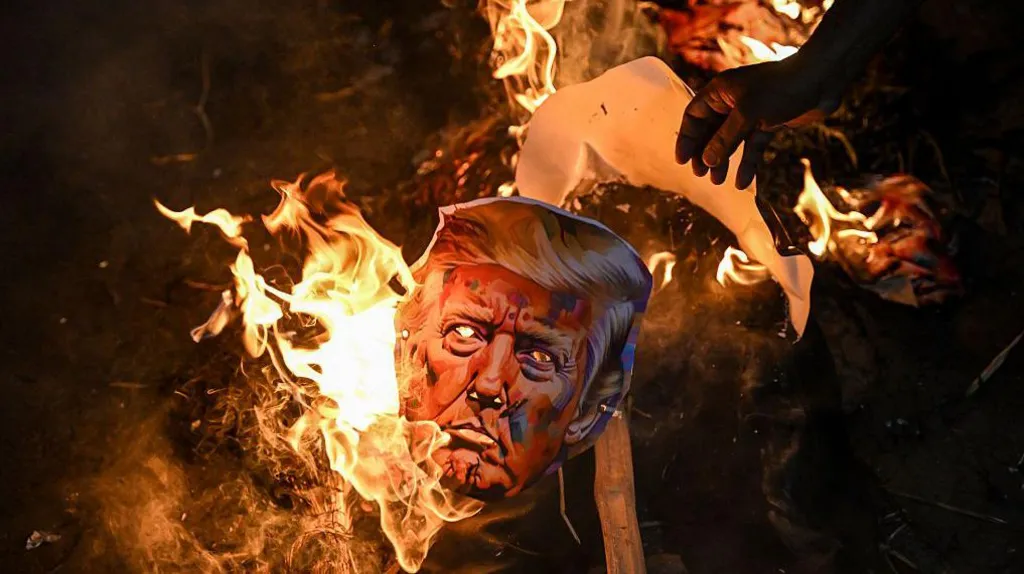
India has claimed that the Trump administration is unfairly punishing the nation, pointing out that other nations that purchase Russian oil are exempt from these taxes. For example, China is the largest consumer of Russian oil, yet its goods are subject to a minimum 30% tariffs India. However, Trump has issued a warning that additional tariffs may soon be imposed on other nations that buy oil from Russia.
The Economic Stakes Tariffs India
Prime Minister Narendra Modi has framed the tariff shock as a catalyst for India’s long-term vision of self-reliance (Atmanirbhar Bharat). In recent speeches, Modi emphasized the need to reduce external dependencies, boost domestic manufacturing, and diversify trade partnerships.
Government officials have already begun talks with key allies in Asia, the Middle East, and Europe to soften the blow of reduced access to the American market. At the same time, New Delhi is speeding up talks with the UK and the EU on free trade deals.
According to Commerce Department figures, the United States purchased $87 billion worth of commodities from India last year, while exporting roughly $42 billion worth of goods to India. American companies were encouraged to look for alternate production destinations like India when Trump increased tariffs India on China during his first term and early this year.
The U.S. is one of India’s top trading partners, with bilateral trade exceeding $190 billion in 2024. A tariff of this magnitude threatens to hit key Indian exports textiles, pharmaceuticals, and information technology services. Indian exporters are warning of potential job losses and reduced competitiveness, while U.S. businesses dependent on Indian goods may also face higher costs.
Experts argue that the tariff could backfire, straining relations at a time when Washington needs New Delhi as a counterbalance to China in the Indo-Pacific region. “This is a high-stakes gamble,” said one trade analyst. “The U.S. risks alienating one of its most important partners.”
Beyond the bilateral fallout, the tariffs India sends shockwaves across global markets. Oil prices could see fresh volatility as India deepens its energy ties with Russia and seeks alternative payment mechanisms outside the U.S. dollar system. As is the case with almost all country-specific duties Trump has enacted, sectoral tariffs such as the 50% across-the-board tariffs India on steel and aluminum, as well as others he has threatened will not be stacked.
As a result, Indian steel and aluminum products will only be subject to 50% tariffs India instead of 100%. Emerging economies watching closely may feel emboldened to challenge U.S. sanctions architecture, accelerating a shift toward multipolar trade networks. By highlighting how these tariffs India are applied, analysts stress the importance of clarity in trade rules even amid escalating tensions.
For India, the challenge is to absorb the short-term economic shock while fast-tracking domestic resilience. For Trump, the move is a political statement ahead of the U.S. elections, showcasing toughness on trade and foreign policy. Whether this tariff becomes a temporary pressure tactic or the beginning of a deeper trade rift will depend on how both nations navigate the months ahead. Oils and gases, chemicals, and aerospace products and parts are among the major U.S. exports to India. These industries may be among the most at risk if New Delhi decides to slap retaliatory tariffs on American goods.
See more of our trusted, verified journalism when you search on Google.