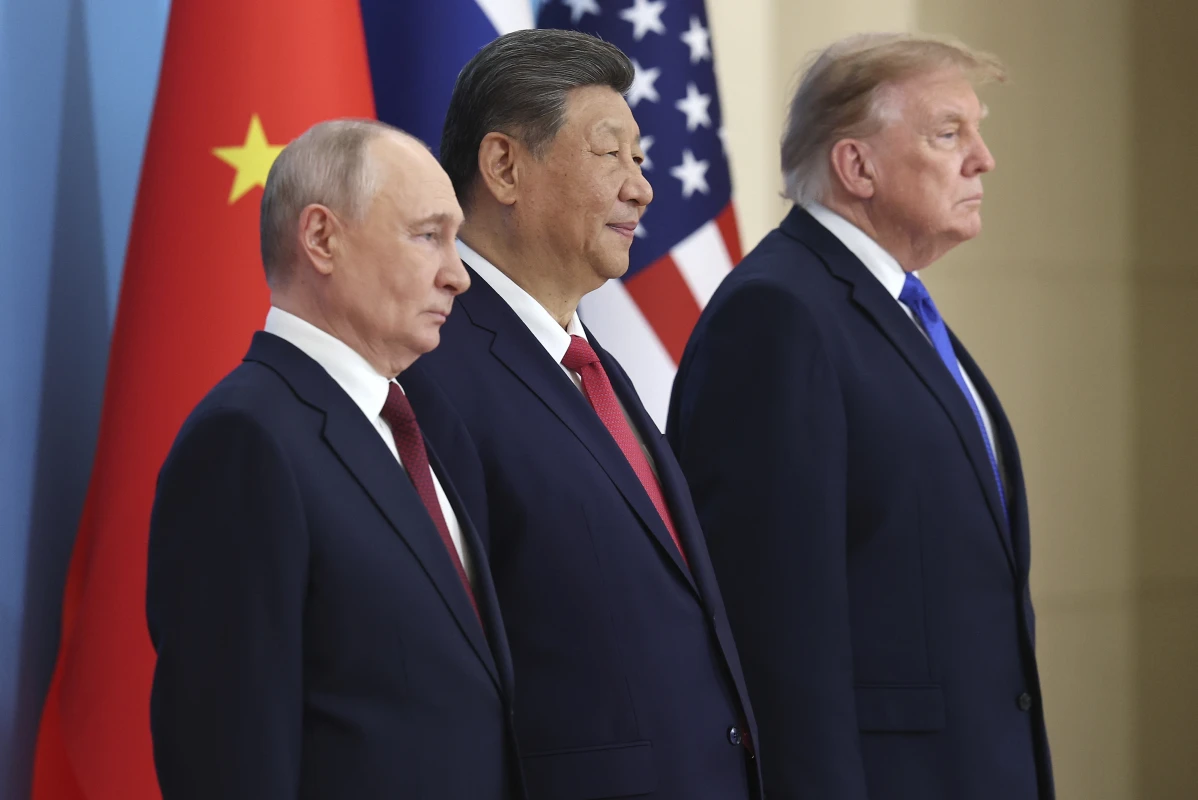
On November 19, an unprecedented trilateral meeting was held in Shenzhen, China between U.S. President Donald Trump, Chinese President Xi Jinping and Russian President Vladimir Putin. The three major global powers met for talks on international security, nuclear risks, energy supplies and the future of global cooperation.
The meeting took place on the sidelines of the Asia-Pacific Economic Cooperation (APEC) summit at Kylin Villa. The first formal trilateral meeting of the three leaders, which attracted world attention amid ongoing wars and rising geopolitic tensions.
The discussions lasted about 90 minutes. Before the meeting, Trump also held separate discussions with Putin and Xi on several issues affecting ties between their countries.
After their discussions, the three leaders issued a joint document called a “Declaration toward Peace,” Reuters reported. The declaration set out areas of interest for cooperation between the United States, China, and Russia but did not set out detailed agreements or binding commitments on several major international disputes.
Nuclear security was one of the key topics at the meeting. Earlier, Trump had called on the three countries to seek ways to reduce nuclear weapons and the risk of nuclear conflict. The United States, Russia, and China hold some of the largest nuclear arsenals in the world, making their positions particularly important in international arms control discussions.
The Associated Press reported that the leaders reaffirmed that nuclear war cannot be fought or won and expressed support for continuing dialog to reduce nuclear risks. But they did not announce any specific agreement to cut their nuclear arsenals or create a new framework for arms control.
The joint declaration also pointed to global energy supplies. The three countries expressed that they supported increasing output and supply of refined petroleum products and stable international energy flows. The statement stressed the importance of energy security for countries that are affected by disruptions in global supply chains.
The leaders also discussed the future of international institutions, especially the United Nations. They backed reforms to the organization to make it more effective in dealing with international challenges, Reuters reported. Their declaration also raised concerns about the jurisdiction of the International Criminal Court (ICC) and similar bodies while stressing the immunity of state officials.
Russia’s war in Ukraine was still part of the wider diplomatic context. Trump said before the trilateral meetings that he had already discussed to Putin about the conflict and expected further discussions about how to end the war. Putin also referred to Ukraine in his opening remarks.
The final joint declaration, however, made no explicit reference to the war in Ukraine. No ceasefire agreement, peace framework, or concrete settlement was announced at the meeting, ABC News and Reuters reported.
The visit of Trump to China was also surrounded by another issue, the conflict involving Iran. Trump had indicated Iran would be among the subjects he wanted to discuss. But Iran or the war in the Middle East was not mentioned directly in the joint declarations.