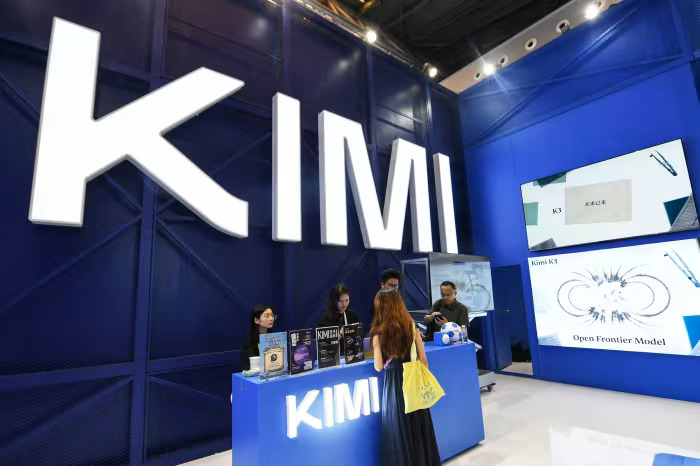
Chinese AI start-up Moonshot AI has launched Kimi K3, a new open-weight large language model that is considered one of the biggest challenges to date to the dominance of leading US AI developers. Claimed as the world’s largest open-weight AI model with 2.8 trillion parameters, Kimi K3 is said to offer performance on par with the top proprietary systems of American competitors.
Another major milestone for China’s rapidly growing AI industry. In the past year, Chinese developers have hastened the introduction of ever more powerful open-weight models, closing a gap many observers had estimated would take years. The latest example of this trend is Kimi K3, which combines frontier-scale performance with an open-weight approach, providing academics and companies with more freedom to deploy and alter the model than traditional closed systems.
According to Moonshot & Reuters Report AI, Kimi K3 contains 2.8 trillion parameters, surpassing previous open-weight AI models in scale. The company said the model delivers performance approaching some of the world’s most advanced proprietary AI systems while remaining openly available to developers, researchers, and enterprises. The release reflects China’s growing confidence in open AI development despite ongoing U.S. export controls on advanced semiconductor technology.
The most recent version is a significant improvement over Moonshot AI’s previous Kimi models. Kimi K3 has a 1-million-token context window that can handle extensive documents, software engineering projects, research jobs, and complicated reasoning. It also has native multimodal comprehension, which allows it to comprehend visuals in addition to text.
According to the business, the architecture has been tuned for demanding workloads that call for advanced problem-solving and continuous context. In a benchmark evaluating web interface-building skills, Arena.ai ranked Kimi K3 top, while Vals AI ranked it second overall, after Fable 5 and ahead of GPT-5.6 Sol. According to artificial analysis, the model performed on tests assessing intricate, multi-step tasks on par with OpenAI’s GPT-5.5 and Anthropic’s Claude Opus 4.8.
Performance, Architecture, and Industry Impact
The launch comes at a critical time in the global AI race, with Chinese developers countering the long-held consensus that they are far behind the US in state-of-the-art AI capabilities. In the past year, companies such as Moonshot AI, Z.ai, MiniMax, and DeepSeek have ramped up development, publishing more capable models and cutting deployment costs with open-weight releases.
One of Kimi K3’s defining characteristics is its open-weight architecture. Unlike proprietary AI models that remain accessible only through commercial APIs, open-weight models allow developers to download model weights, fine-tune them for specialized tasks, and deploy them within their own infrastructure. That flexibility has made open AI increasingly attractive to enterprises seeking greater control over security, customization, and operating costs.
Also Read: Nvidia China Chip Crackdown Company Slashes Asia Buyer List
Moonshot AI also introduced several architectural improvements designed to increase efficiency on a large scale. The company claims that the hybrid linear attention mechanism of Kimi K3 significantly improves long-context processing while reducing computational overhead. With the help of these advancements, the model should be able to perform difficult engineering tasks without needing a lot more hardware than models of this size typically do.
Global Competition and Future Outlook
Moonshot AI’s announcement has piqued the interest of investors and industry analysts, with many seeing it as yet another sign that China’s AI ecosystem is becoming more competitive. The release of Moonshot AI’s Kimi K3 has reignited debate over whether lower-cost, open-weight AI models can reshape enterprise adoption and challenge the commercial advantages enjoyed by leading US developers. Some analysts compared Moonshot AI to previous breakthroughs by Chinese AI companies, which prompted investors to reconsider America’s technological leadership.
The most recent release from Moonshot AI coincides with the growing geopolitical rivalry over AI. In an effort to slow China’s development of cutting-edge AI systems, Washington has tightened restrictions on exports of cutting-edge AI chips to the nation. Despite having limited access to the most cutting-edge hardware, Chinese developers have nevertheless continued to enhance model efficiency and software optimization, allowing for quick advancements.
Moonshot AI’s launch of Kimi K3 marks its most ambitious effort to establish itself as a global AI leader. While the company does not claim outright superiority over every frontier model developed in the United States, its most recent system shows that Chinese AI developers are rapidly closing the capability gap.